

Insights from Sage Eldercare Solutions Professionals: Dance and Targeted Physical Therapy for Parkinson’s Disease
This Parkinson’s Awareness Month, we explore the importance of movement for individuals living with Parkinson’s disease. Our blog, Parkinson’s Exercise Therapy: What We Have Learned, outlines a range of exercise therapies tailored for people living with Parkinson’s disease. Following this blog, we would like to share some in-depth insights from two of our team members, who have extensive experience working with clients affected by Parkinson’s disease.
First, Maria Walsh, an Engagement Specialist at The Hummingbird Project and a teaching artist with Dance for PD®, offers insights into how dance benefits people living with Parkinson’s disease. Second, Nannette Wilkinson, Sage Care Manager with years of prior experience as a dedicated home health physical therapist, shares tips on collaborating with a physical therapist to support functional independence for those with Parkinson’s.
Insights from Hummingbird’s PD Teaching Artist
Hummingbird Engagement Specialist Maria Walsh trained with the Mark Morris Dance Center in Brooklyn, New York, the acclaimed modern dance company that pioneered Dance for PD® in 2001 and subsequently developed an international network of specialized dance instructional programs for people living with Parkinson’s disease. As a teaching artist for Dance for PD® since 2017, Maria shared insights into how and why dance is therapeutic for people living with PD.

How “Busting a Move” Literally Translates to Better Movement
As a certified specialist in Dance for PD®, Maria understands the physical experience of Parkinson’s disease. Dance for PD® is designed to address these challenges, often helping people overcome them. For example:
- Dance can alleviate the motor symptoms of Parkinson’s disease, such as muscle stiffness and rigidity, by introducing ease and flow to the body. Specifically, Maria explained that:
Parkinson’s disease can make individuals feel small and constrained in their movements. However, dance helps to open their bodies and enables larger movements. It encourages individuals to occupy space and extend their limbs and spines, significantly enhancing their movement.
- Another symptom of Parkinson’s disease that dance can help mitigate is a symptom known as “freezing.” Commonly experienced in mid-stage to advanced Parkinson’s disease, freezing refers to a sudden, temporary, and involuntary inability to move. When unable to initiate movement, Maria encourages the “frozen” student to start humming. As Maria describes it, the rhythm develops and deepens, beginning with humming and ultimately evolving into dance.
Humming begins with the vocal cords, followed by fingers snapping a rhythm, hands clapping, and feet stomping, ultimately progressing to a step and walking. Dance rhythm effectively unfreezes the body.
- Apathy is another common aspect of the PD experience. A recent study found that about 40 percent of people with PD experience apathy, a motivational disorder in which people have trouble getting interested in daily activities (Source). As Maria explained, dance and exercise can help reignite interest and alleviate the sense of apathy by increasing endorphins and boosting confidence.
- For people living with Parkinson’s disease, there is a higher risk of feeling lonely and disconnected. Dancing with a class by itself fosters social connection, mitigating loneliness. Maria uses mirroring to amplify the connection among her students. As she explains:
“Mirroring involves pairing with someone and replicating their movements, fostering a bond between two people and an immediate sense of connection,” says Maria. Maria describes that “Being seen by others, uplifted by others, and reciprocating this support—becoming attuned to the body—creates an instant connection and feeling of belonging. It helps alleviate feelings of loneliness and depression.”
Imagination as a Catalyst
In Maria’s Dance for PD® classes, imagination, creativity, and poetry play a role in stimulating movement. As Maria explains:
Maria explains, “I often use poetry in my dance classes as a prompt to create choreography. The visual imagery of poems can inspire participants to harness their imagination, create movement, and express themselves.”
Maria employs imagery and familiar associations to engage her students in movement. Instead of using dance terminology, Maria elicits dance steps by asking her students to make the same movements they would to perform an everyday activity. For instance, she might ask her students to pull open window curtains or reach for an apple in a tree to stimulate hand motions. By translating dance moves, such as port de bras, into everyday actions, dancers can move beyond the idea of performing a dance step and set aside any judgments about their ability to execute it. The familiarity of these everyday movements, coupled with the music, activates the desired movement.
In many cases, dance enables students to assume positions they are not typically in, introducing a sense of openness and accomplishment. This feeling of achievement can be a powerful motivator in the journey of managing the symptoms of Parkinson’s disease.
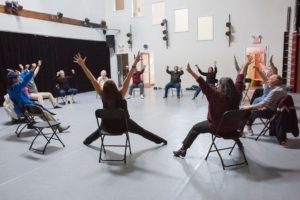
As Maria explains, dance generates endorphins that make people feel good, particularly for those living with Parkinson’s disease. It also provides a platform for creativity, the celebration of life’s rituals, and social interaction. In total, dance can help restore self-esteem and bring joy to participants, thereby enhancing their overall quality of life.
Explore the in-person and virtual dance and exercise resources that Sage has compiled here.
If you are interested in attending one of Maria’s classes, here is the pertinent information:
Motion Pacific Dance: Dance for Parkinson’s, Santa Cruz, CA Hybrid Classes Every Wednesday (Except the First Wednesday) 1:00 – 2:15 p.m.
Insights from a Sage Care Manager on the Benefits of Collaborating with a Physical Therapist for People Living with PD
Nannette Wilkinson, MPT, Sage Care Manager, has years of experience as a physical therapist dedicated to working with clients in their homes. Below, she shares tips on how physical therapy can help those with Parkinson’s disease. She recommends this resource for individuals living with PD: The Michael J. Fox Foundation’s “Make Your Move: Exercise for Brain Health and Life with Parkinson’s.”

Let’s Get Physical (Therapy): Maximizing Movement when First Diagnosed
This excerpt from Make Your Move: Exercise for Brain Health and Life with Parkinson’s highlights the value of physical therapy.
Even if you’re a regular exerciser or have mild symptoms, consider consulting a physical therapist (PT) and/or an occupational therapist (OT) soon after diagnosis. They will test your movement, measure motor and non-motor symptoms that may impact your activity, and assess your physical activity and exercise levels. This is your “starting point” or baseline.
From there, they will design a personalized exercise program to alleviate or prevent symptoms. This is called “prehab” — using therapy early, before symptoms like falls happen, rather than after they come on or cause injury, which is “rehab.” After the initial sessions, at least check in with the physical therapist (PT) and occupational therapist (OT) every six to 12 months. This lets your therapist reevaluate your symptoms, catch changes early, and adjust exercise or therapy for the most benefit.
Nannette’s Recommendations For Optimizing Functioning and Quality of Life with Parkinson’s
When Nannette was providing physical therapy, her recommendations always depended on each individual’s stage and severity of the disease. She has the following tips for optimizing functioning and quality of life with Parkinson’s.
- Start “Pre-hav” as early as possible after diagnosis. See above.
- Discover what exercise works for you. Something is better than nothing. Explore your local Senior Center, Adult Day Health Program, gym, dance studio, or workout buddy to find activities you enjoy. Engagement programs, such as The Hummingbird Project, are also resources to consider, as exercise may be a ‘side effect’ of the activity. For instance, an outing to Filoli involves an extended walk around the gardens, or a Tai Chi sequence with an Engagement Specialist might be focused on grounding, but also serves as exercise. Similarly, preparing a special meal involves shopping, preparing ingredients, utilizing fine motor skills, standing for a prolonged period, and ultimately nourishing the body. Enjoying your exercise routine can make it easier to maintain and significantly enhance your overall well-being.
- Consult professionals for consistent input and suggestions on specific exercises, activities, and programs that could benefit you during various stages of Parkinson’s. Early intervention is crucial!
Four Areas of Focus
Exercise can slow disease progression and improve quality of life. Nannette emphasizes that people living with Parkinson’s disease focus in their exercise training on: Aerobics, Flexibility, Strength, and Balance. Some examples are:
- Aerobic exercise: To improve memory, mood, digestion, and overall well-being, brisk walking, swimming, or biking can provide aerobic benefits.
- Flexibility exercises: To maintain range of motion and reduce stiffness, try stretching and/or yoga.
- Gait training: To improve walking patterns and reduce shuffling or freezing, practice longer strides or use visual cues.
- Balance exercises: To improve stability and prevent falls, standing on one leg, practicing weight shifts, or learning the Tango can contribute to improved balance.
Summary: Sage Eldercare Solutions and The Hummingbird Project’s Experience Can Inform Your Journey and Have a Meaningful Impact on Outcomes
The advice shared by Maria Walsh and Nannette Wilkinson underscores the company’s commitment to delivering personalized solutions for our clients, leveraging the specialized expertise of our professionals. Sage’s three service groups—Sage Care Management, Sage Home Care, and The Hummingbird Project—understand chronic conditions, such as Parkinson’s disease, and collectively provide a whole-person approach to care. Our expertise, professional staff, and focus on quality of life distinguish our services from other options.
If you want to learn how Sage Eldercare or The Hummingbird Project can provide expert solutions for someone you know dealing with Parkinson’s disease, any chronic disease, or any eldercare issue, please schedule a free consultation here.