Parkinson’s Disease Exercise Therapy: What We Have Learned
During this Parkinson’s Awareness Month, we explore the importance of exercise and movement in managing Parkinson’s disease. I share my own personal connection to Parkinson’s disease, and then highlight a variety of exercise options that help those living with Parkinson’s disease alleviate symptoms and improve their quality of life.
My Beloved Grandmother and Early Exposure to Parkinson’s Disease
My connection to people living with Parkinson’s disease (PD) began in my childhood. I used to spend part of every summer with my beloved Granny Pflumm, who would take me to a different beach on the Connecticut shore every day and keep a robust supply of Fruit Stripe gum and rich Swiss chocolate in a special drawer in the pantry. My summer adventures with Granny still evoke fond memories. She was so special to me and is one of the reasons I’ve always been drawn to older adults.
I loved how she spoke with a thick accent, calling me “sweet schatzlein,” and used to make boiled kohlrabi or “spaghettis” for dinner in the pressure cooker, until the noodles became way too thick and way too soggy — all of which I attributed to her Swiss upbringing. There were other things she did that I had a harder time making sense of – she used to laugh hysterically in her sleep, couldn’t smell anything, and her hands shook even when she was holding still. Eventually, my Granny was diagnosed with Parkinson’s disease, and I became attuned to learning about the condition from an early age.
Important Insight into Living Well with Parkinson’s
I had learned more about Parkinson’s disease in graduate school, which built on my early exposure to the condition with my Granny Pflumm’s journey. Fast forward to 2001. When I founded Sage Eldercare Solutions over twenty-four years ago, one of my first clients had just been diagnosed with Parkinson’s, and I accompanied her to the initial post-diagnosis appointment with a neurologist to advocate for her needs to be addressed and to coordinate support services.
The neurologist shared a treatment directive that has stuck with me.
He explained that 50% of optimal outcomes for people living with Parkinson’s come from medication and 50% come from exercise. Medication can alleviate symptoms; exercise holds equal importance. This practical approach to treating Parkinson’s with exercise therapy, in addition to medication, empowers patients by placing an essential aspect of their treatment in their hands. The sense of control that can result can be motivating for those dealing with symptoms of Parkinson’s Disease.
Research on PD and Exercise
Many studies support the neurologist’s advice of 2001. Exercise, particularly vigorous, may provide neuroprotective effects that enhance motor function, cognition, and quality of life in patients with Parkinson’s disease (PD). As I learned many years ago, exercise is now recognized as an effective treatment for Parkinson’s disease (PD) with numerous benefits. (Source)
For the latest research on managing Parkinson’s today, read “Parkinson’s Outcomes Project: Improving the lives of people living with Parkinson’s through research. “ One highlight of the Parkinson’s Outcomes Project caught our attention: people with PD who start exercising earlier and for a minimum of 2.5 hours a week experience a slower decline in quality of life than those who start later. Simply put, exercise has a positive impact on the quality of life for individuals with Parkinson’s.
Sage’s Focus on Quality of Life
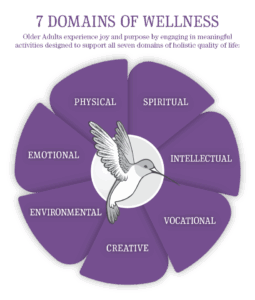
Quality of life has been a central focus of our service offerings since we established our Aging Life Care practice. Today, with all of Sage’s service groups — Aging Life Care, Specialized Home Care, and Quality of Life Engagement services – we consider various aspects of wellness, focusing on each client’s holistic well-being and overall quality of life. To understand holistic well-being, we are guided by seven domains of wellness, which are depicted in the graphic below. Providing services that enhance quality of life encompasses all seven domains.
You can read more about Sage’s approach to wellness in this blog.
I have always been curious about and drawn to the possibilities of creative therapies as a way to address quality of life issues for our clients. The idea of exercising to improve symptoms of Parkinson’s may not appeal to all, but many more may be motivated to know that movements such as dance, tai chi, and boxing classes can be effective and enjoyable options for managing symptoms of Parkinson’s disease. Read on to learn more about unique programs designed to help address the exercise part of the 50% medication and 50% exercise equation suggested by my early client’s neurologist.
Dance: Benefits for Those with Parkinson’s Disease
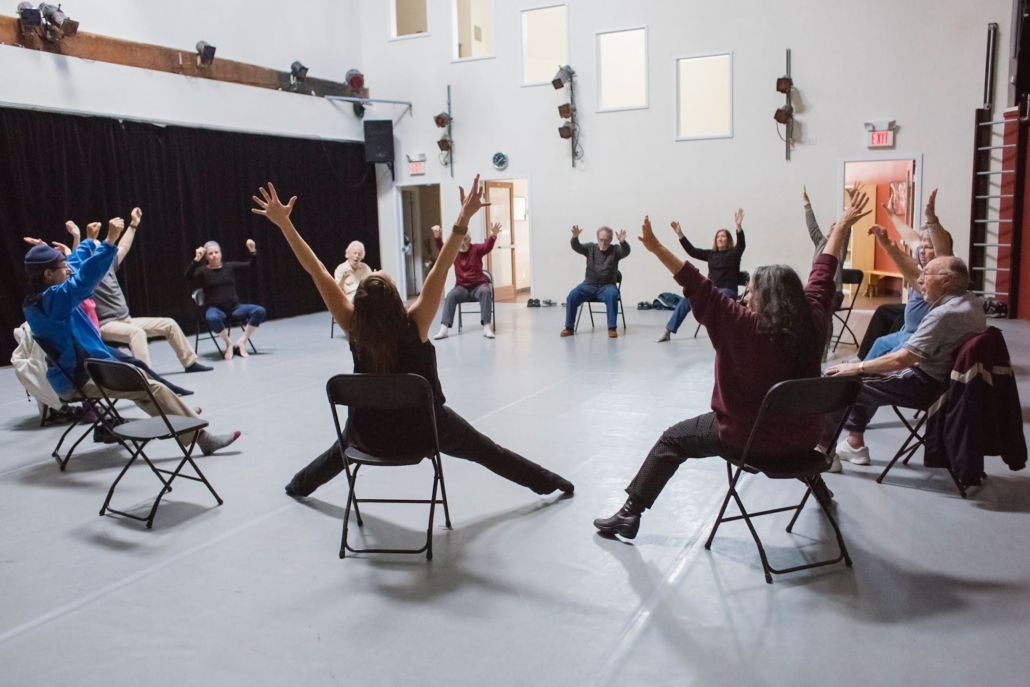
For individuals living with Parkinson’s, dance has been shown to offer numerous benefits. More than a dozen studies have demonstrated that attending dance classes twice weekly enhances balance, motor skills, freedom of movement, and endurance. Source
Dance’s benefits can be multi-dimensional. It can help people living with Parkinson’s physically, mentally, and socially by aiding mobility, stimulating muscle memory, improving balance and spatial awareness, and enhancing overall well-being.
Many neurologists prescribe dance for their patients with Parkinson’s Disease. For example, Stanford professor of Neurology and Neurological Sciences and former professional dancer Helen Bronte-Stewart, MD, incorporates exercise, yoga, and dance as standard therapies for her patients with Parkinson’s disease. She integrates these practices into her patients’ treatment plans.
Tai Chi (Chuan)
Tai Chi is a distinctive form of exercise that originated in China, aiming to balance the forces of yin and yang to promote overall well-being and balance. Studies have shown numerous benefits, including increased flexibility, enhanced body awareness, improved balance and posture, better breath control, reduced stress, and an overall improvement in quality of life. (Source)
According to Dr. Pei-Fan Tang, a professor of Physical Therapy at the School of Physical Therapy at National Taiwan University, Tai Chi is safe for individuals with Parkinson’s at Stage 1, when symptoms are not yet noticeable. (Source)
Boxing
Boxing-based exercise can offer numerous benefits, including improved motor control, balance, coordination, and enhanced mental well-being.
Rock Steady Boxing, a nonprofit organization, offers one of the best-known boxing programs specifically designed for individuals with Parkinson’s disease (PD). The program adapts exercises from the boxing world that emphasize agility, speed, endurance, accuracy, hand-eye coordination, footwork, and strength. The vigorous exercises push the participants beyond what they perceive they can perform. Various levels of training have been developed to meet the needs of people with PD at different stages of the disease.
Participants often cite the non-motor benefits of the connection and camaraderie gained in the classes. Rock Steady Boxing programs reach over 40,000 boxers battling Parkinson’s in 14 countries. Source
Exercise Resources: A Directory of Programs Specialized for People Living With Parkinson’s Disease
For people with Parkinson’s disease, the impact of physical exercise on improving quality of life aligns closely with Sage’s mission. As eldercare professionals in Northern California, we aim to share resources specifically designed for individuals living with Parkinson’s disease, empowering our clients to live their lives to the fullest. We have compiled a list of available in-person and virtual resources below.
A Variety of Exercise Options
Here is an excellent resource for exercise recommendations for those living with PD: Exercise for PD.
Stanford Medicine: Exercise Classes in Northern California
These in-person exercise classes in Northern and Central California are tailored for individuals with Parkinson’s disease (PD). Occasionally, when the same class is offered both in-person and virtually, details for the virtual class are included. Contact your local PD support group leader if you don’t find a class in your area. If in-person classes are unavailable, explore Stanford Medicine’s lists of live online PD exercise classes and PD exercise videos.
Parkinson.org PD Health @ Home
Watch our Fitness Friday videos
Dance
Find Dance Classes for People with Parkinson’s Disease here: Input your zip code to find local classes.
Here are a few options:
Joe Goode Performance Group: Dance for Parkinson’s Class
Joe Goode Annex 401 Alabama St. @17th St. in the Mission, San Francisco, CA 94110 Street parking available
(415) 285-7377
damara@joegoode.org
San Francisco Ballet’s Dance Class for People with Parkinson’s Disease
In-Person and Zoom:
Chris Hellman Center for Dance 455 Franklin Street San Francisco, CA 94102
cbeam@sfballet.org
Motion Pacific Dance: Dance for Parkinson’s, Santa Cruz, CA
Hybrid Classes Every Wednesday (Except the First Wednesday) 1:00 – 2:15 p.m. The Hummingbird Project Engagement Specialist, Maria Walsh, teaches here.
Boxing
Rock Steady Boxing: Fight Back Against Parkinson’s Disease
Rock Steady Boxing was founded in 2006 by Scott C. Newman, who was diagnosed with Parkinson’s Disease at the age of 40. Determined to fight back, Scott trained with former Golden Gloves boxer Vince Perez. He found that boxing training helped control his tremors, making him feel rock-steady.
The non-profit has focused on its mission to improve the quality of life for people with Parkinson’s Disease through a non-contact, boxing-based fitness curriculum. Since its inception, this international network of health and fitness professionals has offered Rock Steady Boxing programs in over 800 affiliate locations in every state and 14 countries worldwide. Search here for locations near you.
Virtual (Zoom)
Stanford Health Care Neuroscience Wellness Center Classes. Online classes include Exercise for Parkinson’s Disease, Tango for Parkinson’s Disease, and Dance for Parkinson’s Disease. In-person classes include Tango for Parkinson’s Disease
213 Quarry Road, Room 1511, Palo Alto, CA 94304. For questions, call 650-736-2234 or email wellnessclasses@stanfordhealthcare.org.
Dance for PDⓇ Zoom Classes (free Zoom classes, streamed from Mark Morris Dance Group’s flagship program in Brooklyn, NY, allow you to enjoy a live, interactive, community experience from the comfort of your home).
Grey Matters Dance Workout (YouTube)
A free Fitness Friday video series focuses on a specific aspect of fitness each week to support people living with Parkinson’s. This series benefits individuals with Parkinson’s and physical therapists seeking effective ways to support and engage their clients.
Sponsored by the University of Utah Departments of Modern Dance and Physical Therapy, Grey Matters: Stretching the Mind, Body, and Soul through Dance offers participants living with Parkinson’s Disease, their immediate family members, and caregivers a chance to experience the numerous pleasures and possibilities that dance and music provide as a form of symptomatic therapy—instructor: Juan Carlos Claudio, MFA, Grey Matters Dance for Parkinson’s Utah.
Support Groups for Caregivers
Stanford Medicine: Stanford Parkinson’s Community Outreach
Parkinson’s Caregiver-Only Support Groups in Northern and Central California
Caregivers need to have their own private support group meetings because they need to vent, share, learn tips and resources, and receive support from others who are walking the same path.
Stanford Medicine: Online Support Groups
Many people find that support groups help them deal with the challenges of having Parkinson’s disease (PD) or being a care partner to someone with PD. Some people prefer online support groups as they are always available, posters can remain anonymous, and posters may receive responses from many people.
UCSF Weill Institute for Neurosciences Support Groups (Patient and Caregiver Support Groups)
UCSF Young Onset PD Support Group
Newly Diagnosed PD Support Group
San Francisco VA Medical Center Parkinson’s Disease Patient and Caregiver Support Group
We hope that these resources are helpful to you. We welcome comments, and we are here to provide expert solutions to address any eldercare needs. Contact us here to schedule a free consultation.