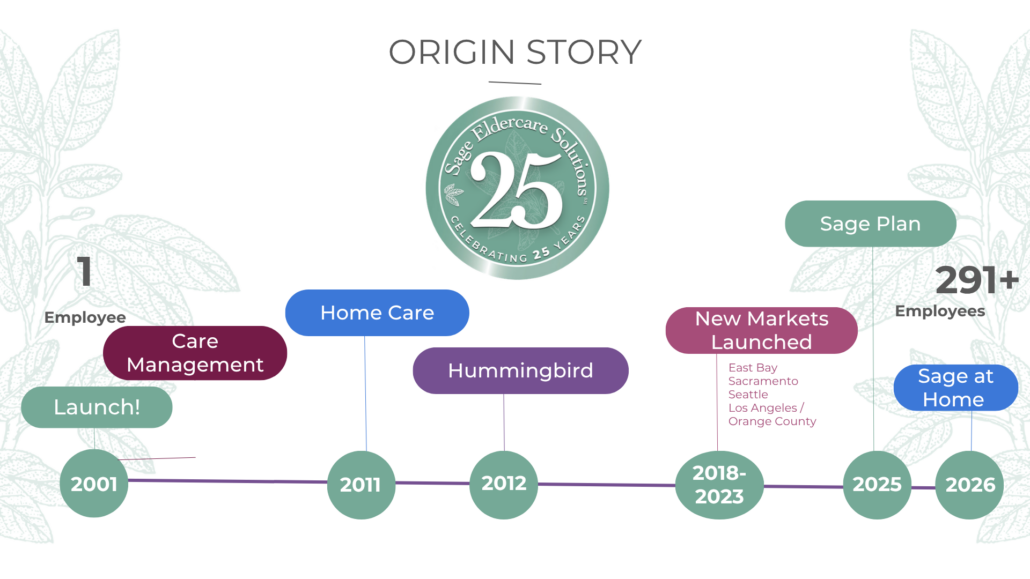
Sage’s Early Years: The Eldercare Landscape
We continue the story of Sage Eldercare Solutions’ founding nearly 25 years ago with the second chapter of our origin story. In this blog, Nina Herndon, founder and executive director of Sage, reflects on changes in the eldercare landscape, how the practice was established in 2001, and how it has since evolved to address unmet eldercare needs.
As Nina Herndon described in the blog post “The Inspiration Behind Sage Eldercare Solutions,” after earning her Master’s in Gerontology in 2001, she began pursuing her mission. Driven by her passion, which Nina refers to as “my undeniable north star,” Nina set out to create a new kind of care management practice.
Eldercare Practice in 2001
Times were different 25 years ago. When Nina started exploring what would become Sage, the Aging Life Care field was relatively new. As President of the Aging Life Care Association today, she believes it is still evolving.
In fact, the landscape of eldercare and care management practices at the beginning of the 21st century highlights some of the changes since then. As Nina observed in 2001:
- The field was known as “geriatric care management.”
- The San Francisco Bay Area had just a few care management practices; yet, two of them were owned and led by mentors Cathy Cress of CressCare in San Jose and Linda Fodrini Johnson of Eldercare Services in Walnut Creek. She believes that Sage was “built on the shoulders of pioneers in the field like them”.
- There was a lack of coordination among healthcare providers, families needed guidance, and quality-of-life needs were largely being overlooked.
Looking back from 2026, as Nina notes, the eldercare landscape in 2001 seemed limited and ready for innovation. Just considering demographics, the number of Americans aged 65 and older has increased by over 75% since then. However, what Nina found most compelling was that people needed help navigating their parent care journeys and didn’t know where to turn.
A New Approach: Applying a Hospitality Mindset
One of Sage’s unique features originated from an unexpected source: Nina’s background in restaurants and hotels. As Nina explains:
I’d worked in really nice restaurants and hotels during college, and learning what it would be like to be treated like a special guest—a concierge-style experience—was really ingrained in my training for those roles.
By applying the hospitality paradigm to the eldercare field, Nina developed a core belief and guiding principles that underpin the Sage approach to eldercare.
By applying a hospitality perspective to eldercare, the quality of life for the entire family—both the older adult and their adult children—receives more attention. I really want to help ensure older people are truly LIVING their whole through – rather than just existing and tolerating discomfort and disability for the last years or months of their lives. I also genuinely want to ease the burden and emotional strain on adult children caring for aging parents, helping them feel supported while they care for their parents.
This new perspective represented a quiet but radical shift in eldercare thinking, emphasizing the family experience as a new priority that goes beyond just meeting an older adult’s immediate needs. An innovative mission was developed to illuminate the lives of clients and their families with feelings of love, comfort, and joy. The goal: to promote genuine well-being and inner peace.
Holistic Care for the Whole System
Nina articulates the novel principle that would become foundational to Sage:
It’s about caring for the entire system—including caring for the adult child—because that ultimately helps the older adult feel at peace with the need for care.
This reframing was the foundation of Sage:
- Adult children weren’t just decision-makers — they were humans under strain
- Emotional burden was as real as logistical burden
- Peace of mind became a legitimate outcome of care
The hope is that older adults can achieve the best quality of life by applying that hospitality perspective.
“Good Care” lacked quality of life
As Sage started working with families, Nina noticed a troubling pattern — people were technically “well cared for,” but not truly living. She saw that the client received attentive support and assistance, but not the care she envisioned. Nina often sums up this gap pointedly:
Having three meals and a bath doesn’t make a good day for you or for me. So why is that enough for an older adult or someone living with a disability?
This realization foreshadowed Sage’s later expansions — but even early on, the philosophy was clear:
- Safety alone is not enough
- Quality of life is not optional
- Care must include meaning, connection, and engagement
Seeing Loneliness
Long before a national epidemic of loneliness was reported, Nina and the Sage team witnessed it firsthand.
We worried about loneliness well before it entered the national conversation. We saw it in clients’ homes.
Clients spent hours alone, often in front of the television — not because they wanted to, but because the system didn’t offer alternatives. It was clear that watching television for eight hours straight doesn’t contribute to a good quality of life. Human connection, interest, passion, hobbies, or a sense of purpose are much more important, none of which come from watching television ad nauseam.
These observations revealed an unmet need that, in turn, motivated Nina and the Sage team to develop Sage’s innovative and most distinctive offerings.
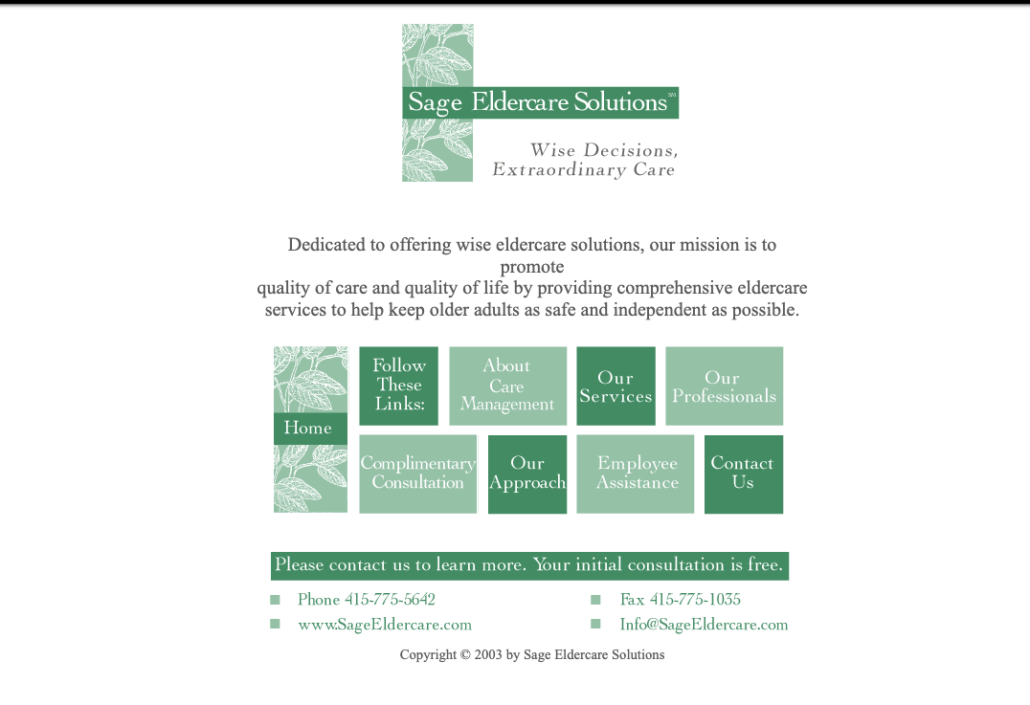
Sage’s First Website in 2003 Reveals the Focus from Day One on Quality of Care and Quality of Life
Evolution driven by need, not business strategy
Looking back, Nina is clear about why Sage evolved the way it did:
“Nothing we created was because we were building a business. It was because we saw a need.”
For Sage, the goal has always been to help their clients experience care differently—something that goes far beyond just three meals and a bath. There was a big disconnect: people might receive attentive support and help, but they lacked the integrated experience that combines support with a sensory element. This holistic approach makes their clients feel truly alive rather than just being cared for.
Growing with Momentum
During Sage’s early years, Nina faced typical startup challenges, including managing all aspects of a new practice. She struggled to find time to balance fieldwork, client-family follow-up, billing, and other administrative tasks. Nina aimed to help people one at a time. After a year working alone, Nina met other “phenomenal people with incredible talent” whom she wanted to team up with to help more people. The shared mission created a snowball effect, attracting other professionals who joined to pursue the same goal.
Additionally, Nina understood that delivering whole-person care requires multiple perspectives. As a result, she began hiring more care managers to build a diverse team with a range of professional backgrounds, including social workers, nurses, individuals with Master’s degrees in psychology and gerontology, and dementia care specialists.
At the same time, news about Sage spread naturally among families in the Bay Area. Often, a client’s family would recommend Sage to other relatives or friends. As Nina explained, Sage supported the entire family ecosystem. Sage’s positive impact on one family member served as the strongest endorsement for others to experience the same care and compassion. Growth occurred one client at a time.
With the team assembled and awareness steadily increasing, Sage gained momentum and was on track to fulfill Nina’s early vision of transforming the eldercare experience for clients that she and the team touched. In our upcoming blog, you’ll learn how Sage expanded its services in 2011 with the launch of Sage Home Care, followed by the debut of The Hummingbird Project in 2012.
If you want to explore how Sage can offer expert solutions for your or a family member’s eldercare needs, please schedule a free consultation here.